The outdoor hospitality sector is booming. Institutional capital is flowing in, acquisition multiples are rising, and a new generation of travelers has rediscovered the appeal of immersive, nature-based experiences. On the surface, it looks like a market where almost any well-located RV resort or campground development should succeed. But spend enough time on the advisory side of these projects and we have, across resorts ranging from boutique glamping concepts to large-scale RV communities and a different picture emerges. Many developments that should perform well don't, and the reasons almost never come down to the market. They come down to planning decisions made in the earliest phases of a project, long before a shovel ever hits the ground.
Here are five of the most costly mistakes we see and what to do instead.
MISTAKE #1: Treating Site Selection as a Real Estate Decision, Not a Design Decision
The most common upstream error in outdoor hospitality development is separating site selection from design thinking. A developer acquires a parcel because the price is right, the acreage is sufficient, and the regional tourism data looks promising, but then hands it to a designer and says, "make it work." The problem is that the physical character of a site isn't just a constraint to be managed; it's the primary driver of the guest experience and, by extension, of revenue per site. A site with significant topographic variation, mature tree cover, and natural water features can command premium site rates and drive repeatvisitation. A flat, featureless parcel of similar acreage requires enormous investment in manufactured amenities to create the same experiential quality; ,if it can be achieved at all.What this means in practice: site selection should involve a design and planning lens from the beginning.
Before an LOI is signed, the questions shouldn't just be "what's the price per acre?"
They should also be:
- What is the natural amenity hierarchy of this site? What site typologies can it support?
- What is the realistic distribution of premium versus standard sites?
The answers directly determine revenue potential, and no amount of design talent can fully compensate for a fundamentally misaligned site acquisition.
MISTAKE #2: Underestimating the Infrastructure Cost Curve
Infrastructure is where outdoor hospitality pro formas most frequently fall apart. Because RV resorts and campgrounds don't look like traditional real estate developments, developers, particularly those coming from residential or commercial backgrounds often underestimate the true cost of servicing them. The challenge is density and distribution. A 200-site RV resort spread across 80 acres requires water, sewer, power, and data connectivity to reach every individual site across that entire footprint. The linear footage of underground utilities, pump station requirements, and electrical panel load calculations scale with the site's geography in ways that aren't always intuitive from a site plan.
The result: infrastructure costs budgeted at 20–25% of total project cost frequently land at 35–40% once engineering is complete. That's a gap that can render an otherwise viable project unbankable, or force value-engineering decisions that compromise guest experience and long-term asset performance. The fix is front-loading engineering input into the feasibility stage - a proper infrastructure cost model should be a prerequisite to any capital commitment.
MISTAKE #3: Designing for Maximum Site Count Instead of Maximum Revenue Per Site
The instinct to maximize site count is understandable. More sites means more revenue, right? Not always and in many cases, the opposite is true. In outdoor hospitality, revenue optimization is not a function of site count alone. It's a function of the mix of site typologies and the experiential quality of each site relative to its rate. A 300-site resort with a thoughtful mix of premium pull-through sites, glamping tents, and waterfront cabins will almost always outperform a 400-site resort of undifferentiated RV pads, even if the second resort has higher theoretical capacity.
This matters because the development instinct often reinforced by lenders who underwrite on a per-site basis pushes toward density. And density, applied indiscriminately, destroys the very thing outdoorhospitality guests are paying for: a sense of space, nature, and escape.
The planning discipline required here is what we call site yield optimization: treating the site plan not as a packing exercise, but as a revenue architecture decision.
MISTAKE #4: Treating Amenities as an Afterthought
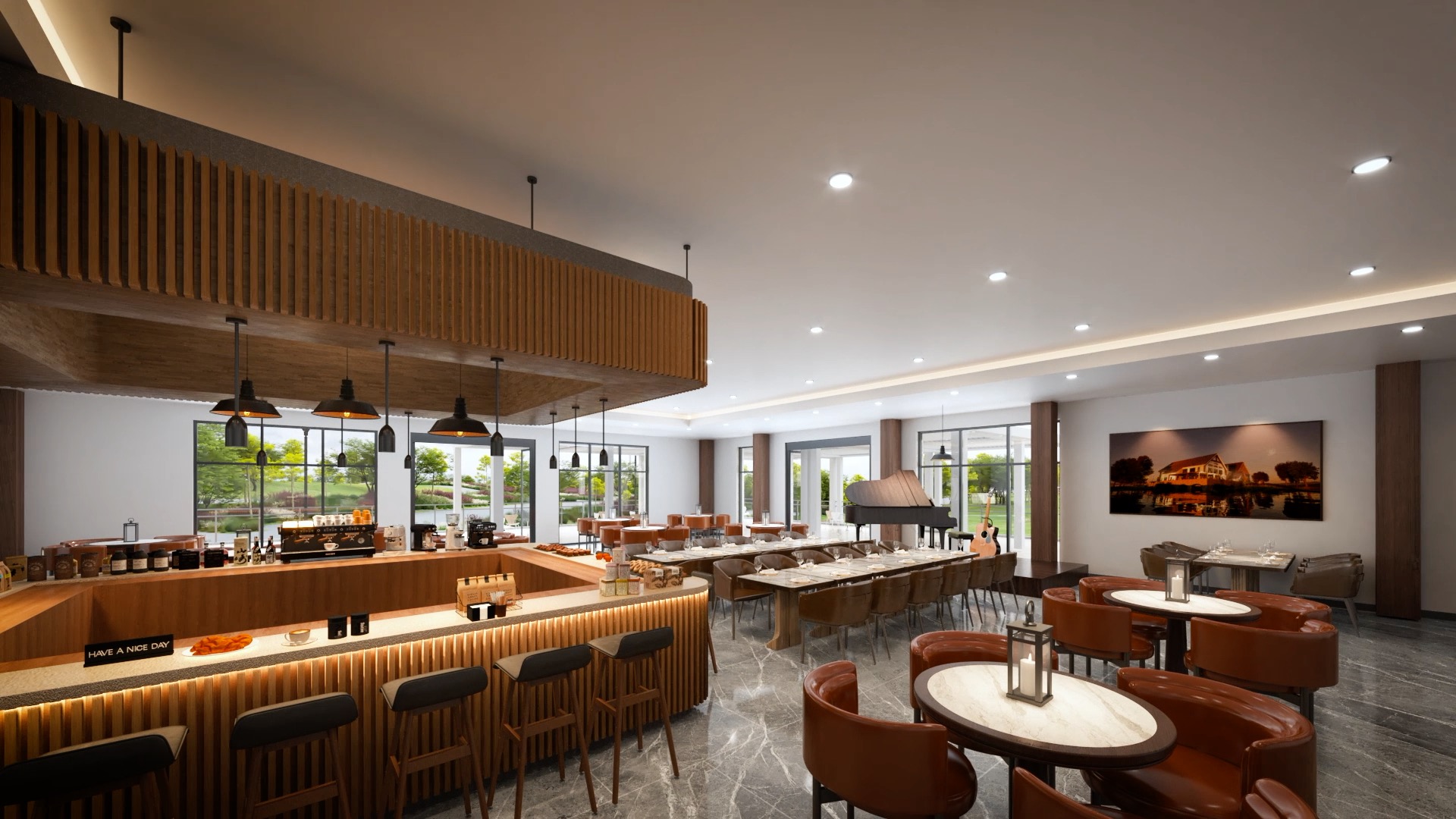
In outdoor hospitality, amenities are not amenities in the traditional real estate sense — they are the product.
The resort's pool complex, its trail network, its event pavilion: these aren't things that support the guest experience, they are the guest experience. And they are what drive the rate premium that separates a $75/night RV site from a $175/night one.
Yet in most development schedules, amenity design is deferred until late in the process. The site plan getslaid out around circulation and utility routing, sites get placed, and then the remaining land and whatever's left gets assigned to amenities. The result is amenity areas that are residual rather than intentional: undersized, poorly located, and disconnected from the overall site experience.
The design principle that should govern this instead: amenities first, sites second.
The resort's primary amenity zone should be located based on what makes the best guest experience, typically at the heart of the site, with high visibility from arrival, and natural connections to the landscape. Sites then get organized around that amenity core.
MISTAKE #5: Skipping the Regulatory Feasibility Phase
Zoning, permitting, and environmental review are the most chronically underestimated elements of outdoor hospitality development timelines and the most likely to kill a project that has already consumed significant predevelopment capital.
RV resorts and campgrounds exist in a regulatory grey zone in many jurisdictions, neither residential nor commercial in the traditional sense which means local zoning codes frequently don't address them clearly. A site that appears to be zoned appropriately may require a conditional use permit, a rezoning, or a variance involving public hearings and political risk. A site adjacent to a wetland or sensitive habitat may face environmental review requirements that add 12–24 months to a development timeline.
None of this is necessarily fatal, but it needs to be known at the feasibility stage, not after site acquisition.
A proper regulatory feasibility review:
- Maps the permitting pathway,
- Identifies material risks,
- Estimates the timeline
- Sizes potential mitigation costs.
It converts unknown unknowns into known knowns - the minimum standard of due diligence before a capital commitment of this magnitude.
The Common Thread
Each of these five mistakes shares a root cause: treating the planning phase as a cost to be minimized rather than an investment that protects everything that comes after it.
The predevelopment phase of an outdoor hospitality project is where the revenue potential of the asset is set and where the risks that can undermine it are either identified or missed. The cost of rigorous feasibility work is a fraction of the cost of a single significant miscalculation downstream.
At Nadi Group, our advisory services exist precisely to close this gap bringing design intelligence, market insight, and planning discipline to the earliest stage of a project, before commitments are made that are difficult to reverse.
The goal isn't to complicate the path to development. It's to make sure the path leads somewhere worth going.